
Why Endoscope Quality Testing Is Becoming a Strategic Advantage for OEMs
Across the industry, OEMs are seeing the same pattern: more scopes in circulation, more service pressure, and more questions from hospitals about performance consistency. With that comes a renewed focus on how endoscopes are tested throughout their lifecycle. Quality testing is becoming a way to manage risk, improve service decisions, and build trust with customers.
The limitations of human inspection
For decades, visual inspection has been the primary method for assessing endoscope quality. Technicians look for scratches, bends, cloudy lenses, or obvious damage. But real‑world evidence shows that this approach misses a lot.
In a study comparing human inspection with objective measurements, trained clinicians rated nearly 80% of scopes as acceptable, while automated testing classified the same population as failing more than three‑quarters of key performance criteria. In one evaluation of 166 endoscopes, only about 13% truly met measurable performance thresholds, despite passing visual checks.
Subtle optical issues including reduced illumination, light non‑uniformity and early lens degradation can affect visualization during procedures yet easily escape the naked eye.
Takeaway: Objective metrics reveal what visual inspection can’t, and that visibility gap can have real implications for clinical performance and consistency.
Real-world performance variation is larger than you might think
Endoscopes don’t all age equally. In real clinical settings, performance varies widely across units. Long‑term data shows that some rigid scopes work well for hundreds of uses, while others start to lose image quality after only a few dozen procedures. Repaired units often show clear drops in performance compared to new ones.
For example:
- Some scopes maintain consistent illumination and image quality across hundreds of uses.
- Others lose optical performance much sooner.
- Repaired scopes often show significant reductions in light transmission, even if they appear “fine” on visual inspection.
Without objective testing data, these variations can easily go unnoticed, leading to inconsistent repair decisions, unnecessary unit swaps, and unpredictable performance in clinical use.
Takeaway: Quality testing transforms intuition into insight — giving OEMs clear data on performance trends rather than assumptions.
A growing data gap OEMs cannot ignore
Beyond individual scope variation, hospitals often lack the data needed to understand how their entire inventory performs in daily practice.
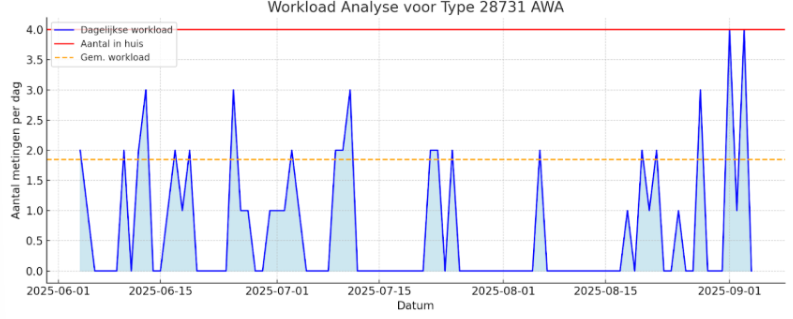
The dataset below comes directly from a hospital using our LightControl system. LightControl captures objective measurements of each scope and stores them in Endoscope Manager, giving hospitals and OEMs the reliable data needed to understand how scopes are actually performing and how many are truly in rotation on their busiest days.
By comparing real usage with total inventory, this data makes it possible to see when a hospital is operating near its limits and when it is maintaining far more scopes than it needs. It also highlights early performance decline and workload peaks that would be difficult to detect through visual checks alone. For OEMs, having access to this level of real‑world data opens the door to a more proactive partnership with hospitals, supporting better service decisions and more accurate inventory planning.
In the graph below the x‑axis shows the date, the y‑axis shows how often this scope type is used per day, and the red line (“Aantal in huis”) shows how many endoscopes the hospital has in stock. What we see is that daily use reaches the full inventory on its busiest day, meaning there’s no backup scope available if one fails.
The next graph shows the current quality of each scope. The x‑axis lists the individual scopes, and the y‑axis shows their most recent quality score measured by LightControl. This makes it easy to see which scopes are performing well and which ones are already showing early decline and most likely to fail or need service soon.
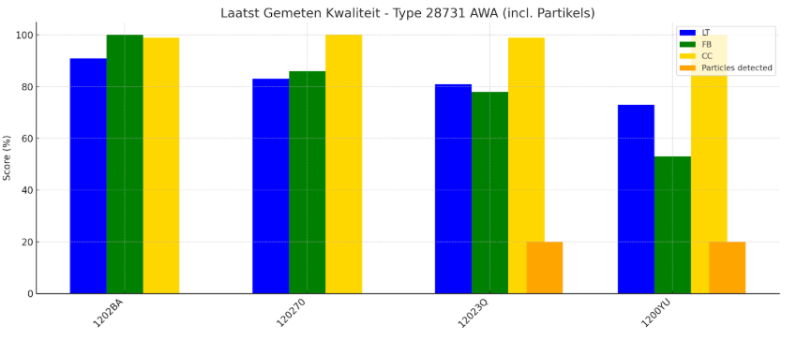
Takeaway: Real‑world LightControl data provides the foundation for insights into performance drift and true inventory needs, enabling OEMs and hospitals to collaborate more proactively and plan with confidence.
Quality data is a compliance asset, not only a checkpoint
Regulatory environments are tightening. Under frameworks like the EU Medical Device Regulation (MDR), manufacturers are expected to demonstrate not just that devices are safe at release, but that performance remains controlled throughout the lifecycle.
Objective test results, with time-stamped records and numeric metrics, provide the traceability regulators are increasingly asking for. In contrast, subjective inspection notes or technician opinions carry little weight in documentation or audits.
This shift isn’t hypothetical. Leading OEMs and notified bodies alike are placing greater emphasis on measurable performance data during conformity assessments and post-market vigilance.
Takeaway: Documented quality testing helps OEMs satisfy regulatory expectations and defend performance claims with evidence rather than interpretation.
Quality testing drives operational efficiency
Beyond inspection, quality testing supports service strategy and decision‑making:
- Faster turnaround times through clearer pass/fail criteria
- Consistent standards across global repair centers
- Insight into recurring failure patterns that can inform design or supplier choices
Clinical surveys also show that optical issues such as blurry images, loss of focus, or reduced illumination are common in real procedures. In a data‑driven review of more than 12,000 procedures, over 70% of clinicians reported problems with image clarity or illumination during use, and nearly half of endoscopes required service or replacement after fewer than 50 cases.
Takeaway: Quality testing not only detects failures but it prevents them from becoming recurring operational costs.
A competitive edge in a crowded market
Healthcare providers are becoming more selective buyers. They want equipment that performs consistently, backed by transparent service practices and defensible documentation. OEMs that can demonstrate controlled quality across the product lifecycle, not just at point of sale, gain a strategic advantage.
Today, objective testing data supports:
- Predictive service models
- Better resource planning across repair networks
- Transparent communication with customers
- Data-informed product improvements
These capabilities enhance customer confidence, especially in markets where uptime and reliability directly affect clinical outcomes.
Takeaway: Quality testing data becomes a commercial asset as much as a technical one.
Quality testing as a strategy

Endoscope quality testing is a source of visibility, insight, and strategic value. One that can accelerate service efficiency, strengthen compliance postures, and reinforce brand trust.
OEMs that embrace objective testing as part of their standard operating model, will be better positioned to navigate regulatory expectations, optimize service performance, and differentiate themselves in a competitive market.
Have thoughts or questions? We’d love to hear from you! Share your thoughts in the comments below! 👇