Endoscope Repair and Quality Standards: Why Objective Testing Benefits Everyone
The endoscope repair landscape is complex. Hospitals need reliable instruments. Manufacturers want their quality standards upheld. Repair companies want to demonstrate the quality of their work. And regulators are placing increasing emphasis on documented, traceable evidence of device performance.
What all of these stakeholders share is a common interest: endoscopes that perform to the original specification, every time they enter the operating room.
The challenge: quality is invisible without the right tools
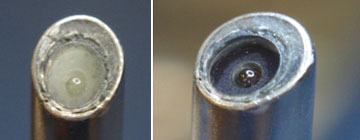
When an endoscope is returned from repair, how does anyone know it truly meets the original performance standard? Visual inspection has limits. A scope can look fine and still transmit 30% less light than it did when new. Lens degradation, fiber loss, and subtle optical issues are invisible to the naked eye — but not to a patient.
This is the core challenge for everyone involved in the endoscope lifecycle. Without objective measurement, quality is a matter of opinion. And in a clinical environment, opinion is not enough.
A shared standard changes everything
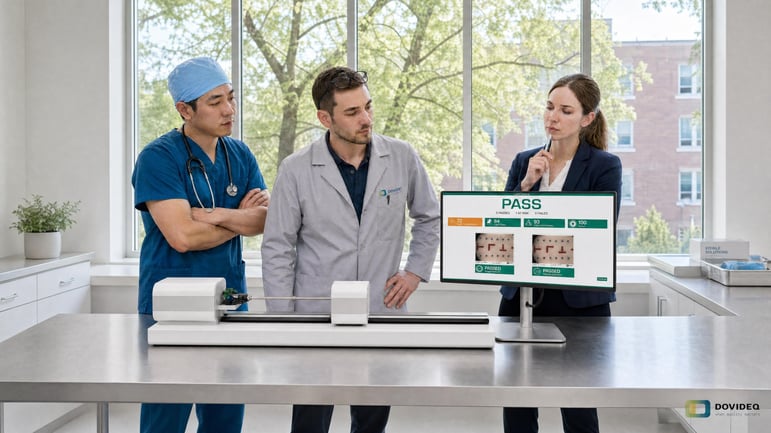
When objective testing is applied consistently — before and after every repair, and at regular intervals during clinical use — something important happens: quality becomes measurable, comparable, and defensible.
For hospitals, this means clear evidence that every endoscope in circulation meets the performance threshold required for safe clinical use.
For manufacturers, it means an objective record that their specifications were met — or not — at every stage of the device’s lifecycle.
For repair companies, it means the ability to prove the quality of their work with data, not just assurance.
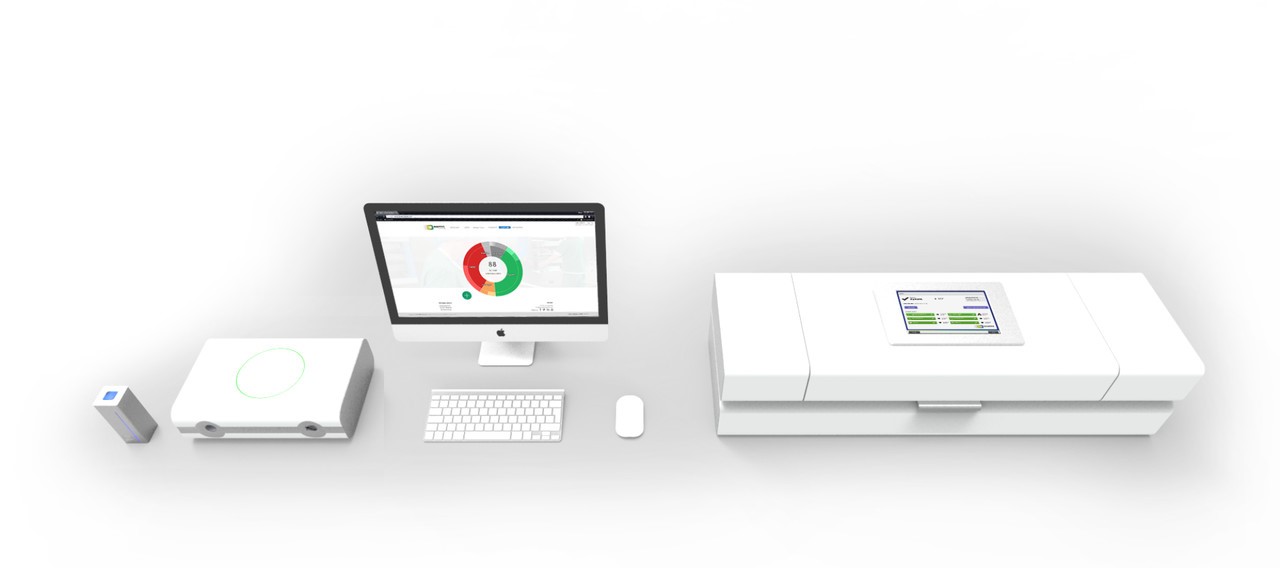
This is exactly what LightControl and EndoscopeManager from Dovideq are designed to support. LightControl provides automated, objective measurement of rigid endoscope performance across six key parameters. EndoscopeManager stores every test result in a cloud-based, traceable record — accessible to whoever needs it, whenever they need it.
Compliance is not optional - it is the foundation
Under frameworks like the EU Medical Device Regulation (MDR 2017/745) and ISO 17664, the expectation is clear: performance must be documented throughout the device lifecycle. Subjective inspection notes no longer meet the standard that regulators, notified bodies, and hospital accreditation bodies increasingly require.
Objective test data — timestamped, traceable, and measured against defined thresholds — is what fills that gap. It protects hospitals in audits. It gives manufacturers a defensible record. And it gives repair companies a way to demonstrate that their work meets the original specification.
The bottom line
The question of who repairs an endoscope matters less than the question of whether it performs to standard when it goes back into use. Objective testing answers that question — for everyone.
When the quality of an endoscope can be measured, verified, and documented at every point in its lifecycle, the entire ecosystem benefits: better outcomes for patients, less risk for hospitals, clearer accountability for all parties involved.
That is the standard Dovideq is built to support.
and compliance workflow — for your hospital, service team, or
organisation.
Book a demo →
Comment below — do you use objective testing for endoscope repair? 👇